


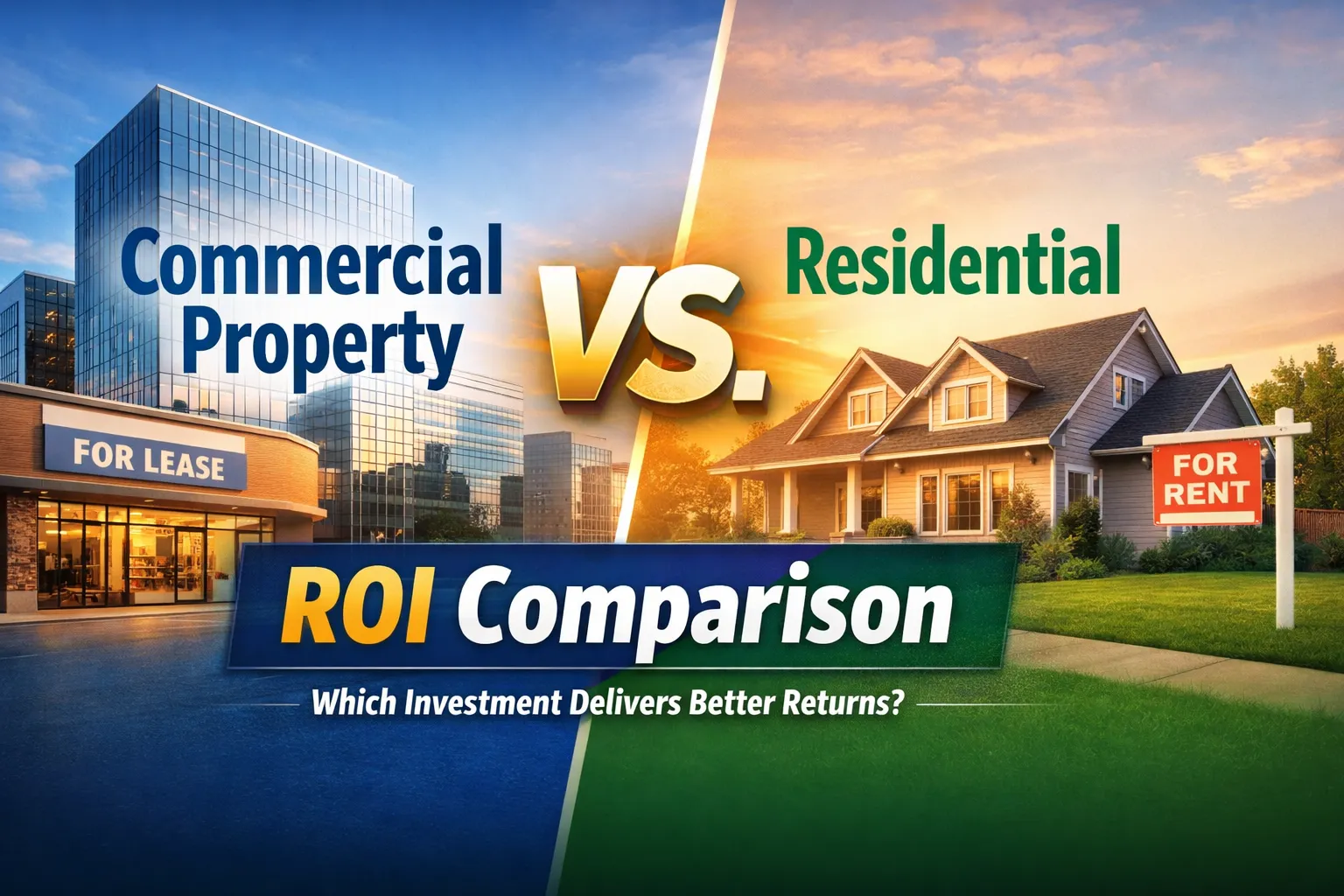
Commercial Properties vs. Residential: A Comparison of ROI
Amongst the most burning questions on the agenda of every real estate investor is one: should I invest in commercial property or residential property?
Both can be quite viable, but returns come in very different ways with differing risk profiles. Understanding how return on investment compares between commercial and residential real estate will, therefore, be a way to clarify the most appropriate strategy for one's objectives, risk tolerance, and time horizon.
Understanding ROI in Real Estate Insights Newsletter Volume 1
Factors that affect the ROI in the real estate sector include:
- Rental income
- Operating costs
- Financing costs
- Appreciation
- Tax benefits
Even if calculations for ROI may resemble each other in calculations, motivating factors for the return vary greatly between commercial and residential.
Commercial Property: More Revenues, More Complexity
The commercial property types that include office buildings, retail centers, industrial warehouses, and multi-family structures with at least five units may give more possible returns than residential real estate.
- Average annual ROI usually varies from 6%–12%+
- Cap rates are usually higher than residential rates
- This increases cash flow since income from a six-year lease would
Advantages
- Improved cash flow: Leases for commercial properties typically yield higher rent-per-square-foot income.
- Triple Net Leases: The tenant may agree to pay the taxes, insurance, and maintenance
- Income statement relationship/Value linked to income: An investor can enhance the value by maximizing the income statement
Challenges
- Higher purchase prices and capital requirements
- Even more complex management and leasing
- More attunement to economic cycles
- Best for: Experienced investors looking for scalable income and value-add strategies
Residential Property: Stability and Accessibility
In residential real estate, such as single-family homes, duplexes, triplexes, and four-plexes, investments may be more accessible to first-time real estate investors with more moderate returns.
- Average annual ROI generally ranges from 4%–8%
- Returns are typically dependent on appreciation
- The financing is generally more favorable and more accessible
Advantages
- Lower entrance costs
- Easier financing with longer amortization
- Consistent demand driven by housing needs
Challenges
- Shorter leases and higher tenant turnover
- More management-intensive per unit
- Rent control and tenant protection laws in some markets
- Best for: New investors or those seeking stable, long-term appreciation with lower complexity
Which Investment Yields Better ROI?
If your goal is cash flow or value creation, then commercial real estate tends to produce a better ROI.
If a predictable income stream with potential for appreciation is what's sought, residential properties might prove to be a better investment option.
By the way, diversified investors will usually make both investments. It is also important to highlight the fact that market conditions should be taken into consideration. A well-located residential property can perform better than that of a commercial property, and vice versa.
